

It’s tempting to frame autonomous driving as a single leap. In public transport, adoption tends to be incremental – because the system is built for reliability, and new capabilities have to fit into daily operations without disrupting service. That is why a practical strategy is evolution, not revolution: introduce autonomy in a defined domain, learn safely in real operations, and expand capability step-by-step.
Start in a controlled operating domain
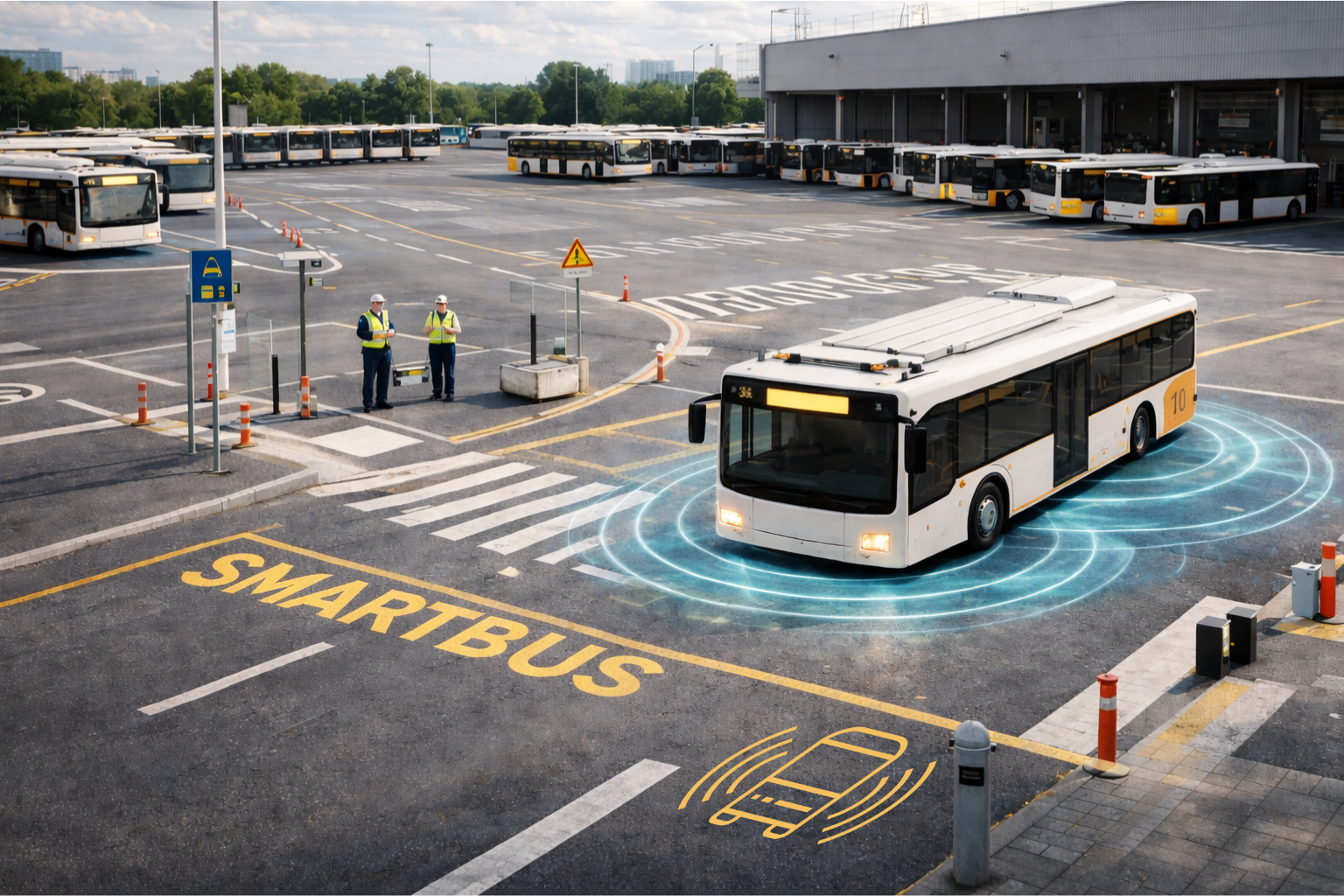
Autonomy becomes operational when it starts in an environment that is predictable, bounded, and safe to learn in. In depots, autonomous movements typically happen at low speed and without passengers on board, which makes early deployments easier to manage and supervise.
Depots are full of repeatable, non-revenue movements:
- staging and repositioning
- parking and re-parking
- moving to charging, washing, servicing
- queueing and shunting
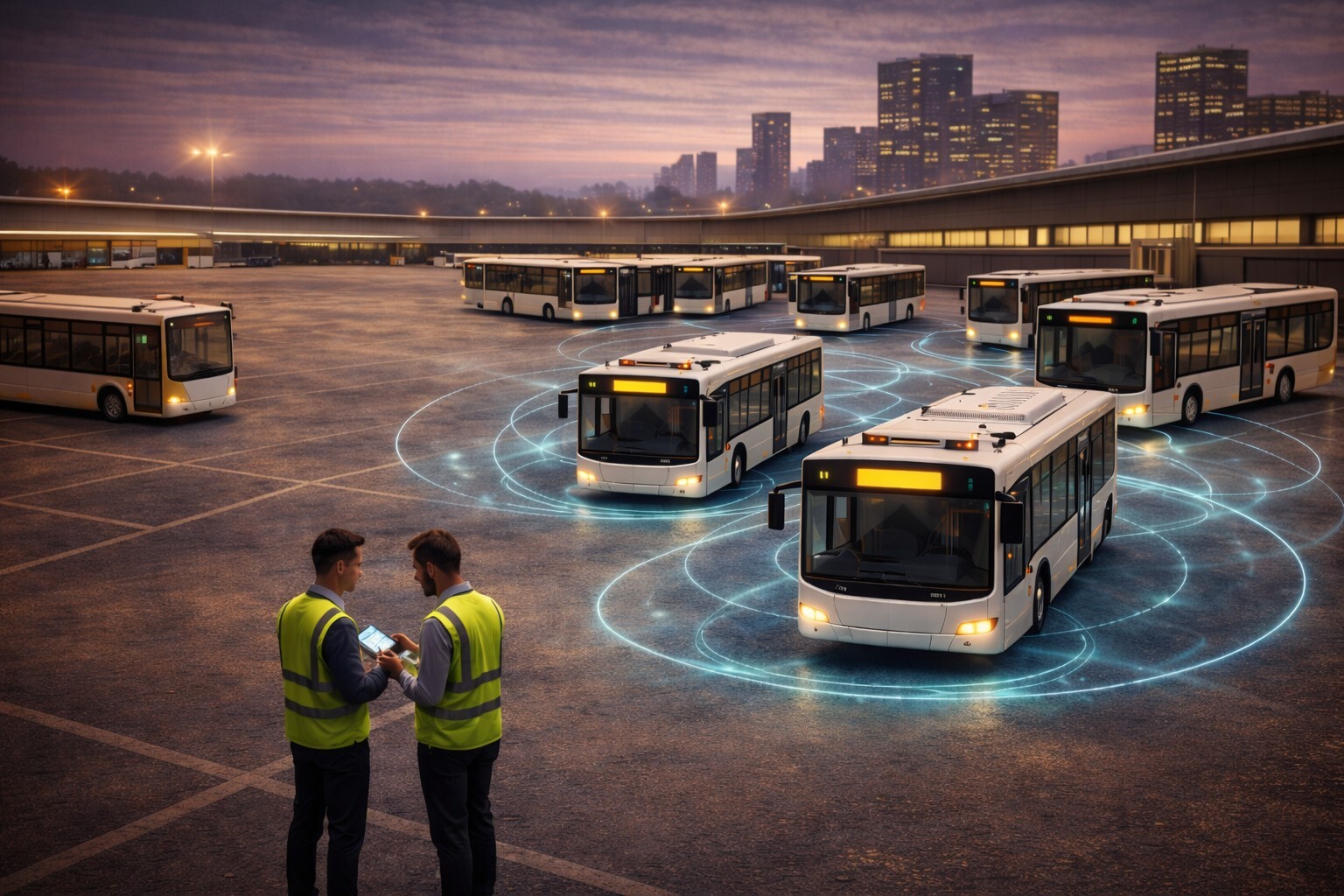
These activities are necessary, but they consume time and capacity. When autonomous driving reduces the manual effort required for depot manoeuvres, the value shows up early in operational terms that are easy to track: recovered driver time, smoother depot flow, and fewer bottlenecks.
That’s why depot-first autonomy is often a practical starting point. It links the learning phase to daily operational outcomes.
What de-risking looks like in real operations
Operators do not adopt autonomous driving as a feature. They adopt an operating capability. De-risking therefore has to cover several layers at the same time:
- Technical: consistency in your depot layout, lighting, weather, and daily variability
- Operational: integration with dispatch, parking, charging, washing, servicing, and shift routines
- People: how drivers, depot staff, supervisors, and maintenance teams interact with the system
- Process: H&S procedures and operating rules, including stop/recovery, exception handling, and how operations resume
- Organisational: whether the change can be absorbed without reducing service reliability or increasing operational overhead
A staged approach makes this manageable. It turns uncertainty into specific questions the organisation can answer with evidence from its own environment.
Why pilots become permanent
Many autonomous driving programmes slow down not because progress stops, but because the programme never shifts from learning activity to a sustainable operating model. Two factors tend to drive that outcome:
Heavy up-front investment before value appears.
Some approaches involve significant up-front capital and implementation effort before benefits are realised. Where costs are tied to a specific setup and require a fleet-wide rollout to achieve acceptable amortisation, deployment is more likely to remain limited to pilot scope.
Learning that does not improve the cost base.
Autonomy demonstrations can be valuable for technical maturity, but if a safety driver (a human driver on board during autonomous operation) is still required and the autonomy stack remains expensive, the programme can remain a learning exercise. Scaling then becomes difficult, because every additional vehicle adds cost without changing the underlying operating model.
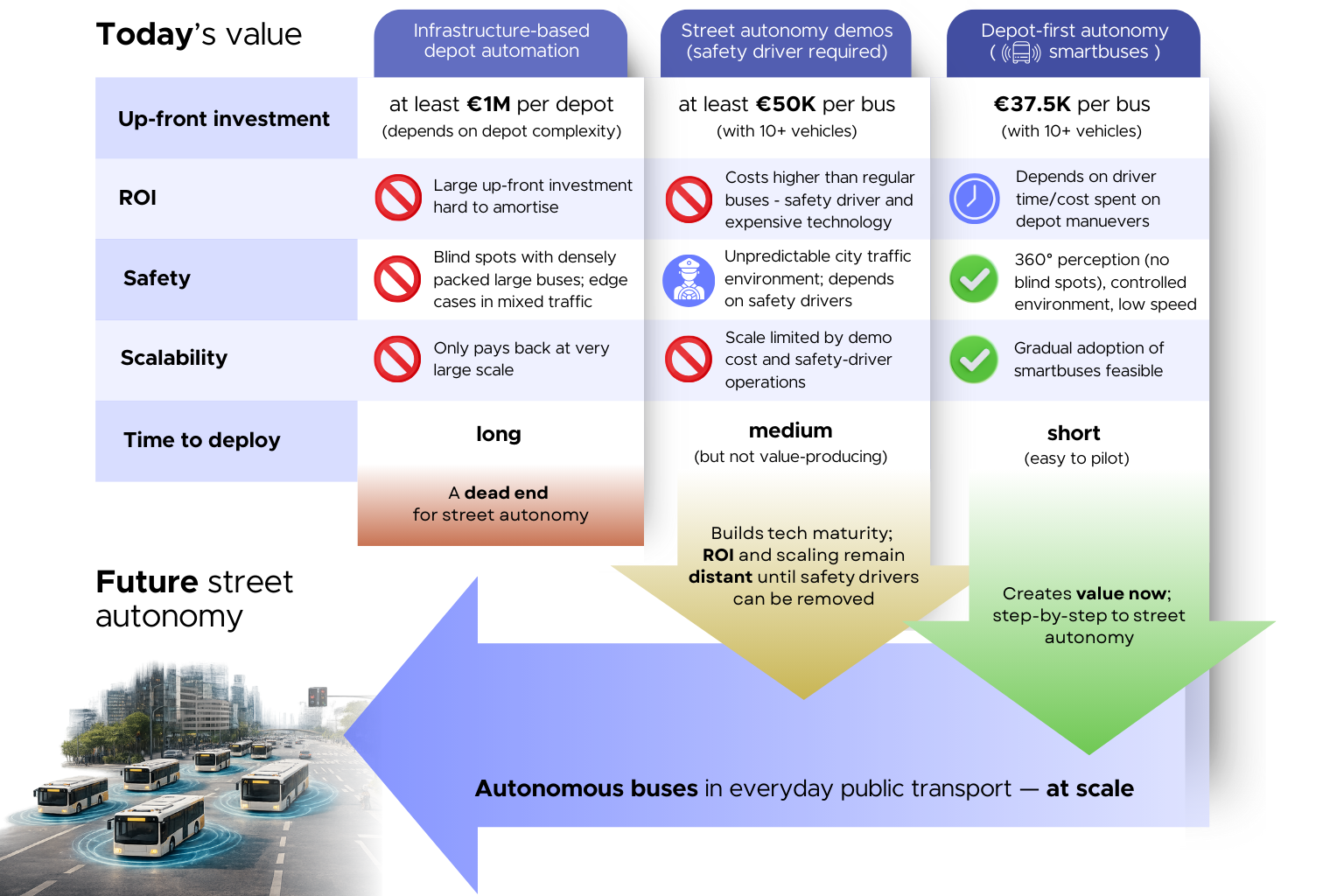
The comparison summarises the trade-offs across up-front cost, time to deploy, safety envelope, scalability, and where (or whether) ROI shows up during the learning phase.
Smartbuses – buses equipped with technology for autonomous movements inside the depot – make the adoption trade-offs simpler and more actionable in three ways:
- Avoiding a large, up-front, site-specific investment before benefits begin.
- Eliminating dependence on safety drivers.
- Linking ROI to local inputs: depot manoeuvre time and total labour cost.
In one line: it links near-term savings with step-by-step readiness for more complex autonomy. Evolution, not Revolution.
Scaling without disruption
The rollout pattern is one operators already recognise from electrification and other complex transitions:
Stage 1: One vehicle
Validate feasibility in your depot, define the operating boundaries, establish staff procedures, and train the first team.
Stage 2: Small fleet
Move from “does it work?” to “can we run it routinely?” Integrate with depot workflows and measure stability across shifts and conditions.
Stage 3: Larger volumes
Standardise training and operations, reduce overhead through repeatability, and improve unit economics as the fleet grows.
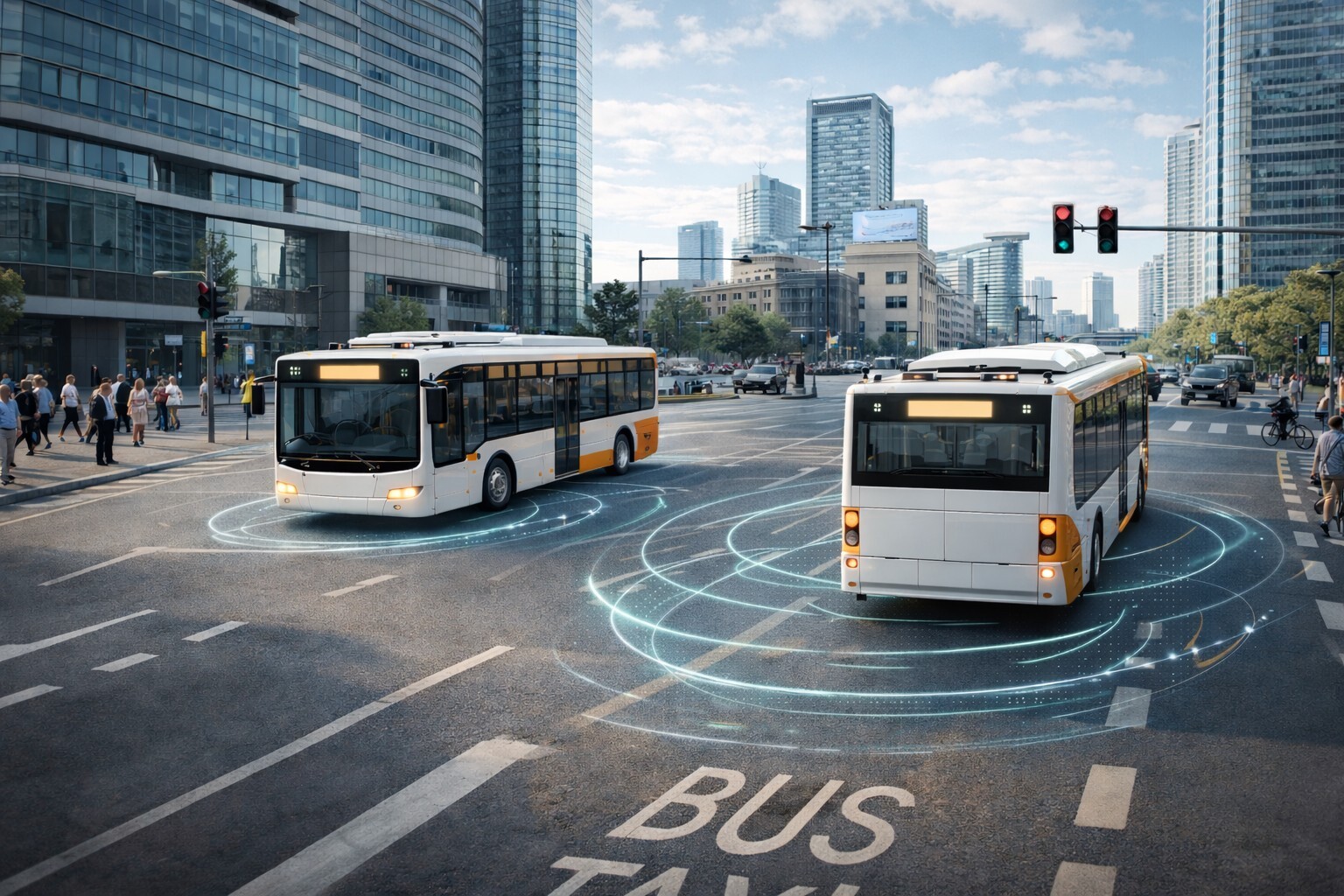
At the end of this progression, operators have trained teams who understand how autonomous driving behaves, procedures that make exceptions manageable, and performance that can be tracked week after week. In public transport, that’s how autonomous driving becomes real: start in a controlled operating domain, learn in day-to-day operations, and scale what works without disrupting core service.
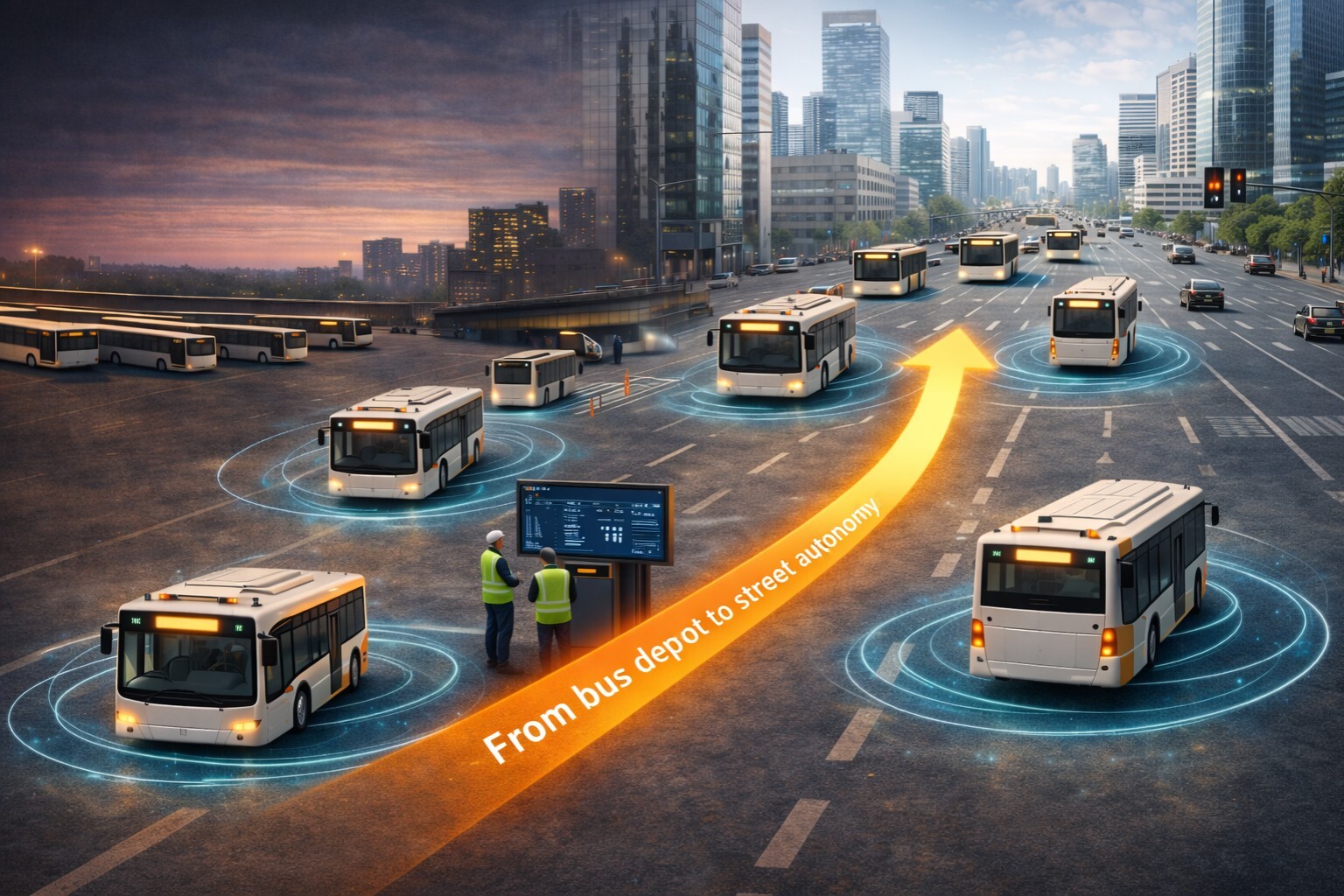
Street autonomy is the destination. Evolution is how you get there without breaking reliability.
Discover the Smartbus Onboard Program
The Smartbus Onboard Program helps public transport operators turn their depot into a safer, more efficient, and autonomous operation with flexible engagement levels tailored to your fleet and roadmap.
Smartbus Ready
Define autonomy impact on operations, ensure H&S compliance, establish training protocols, and de-risk implementation
Smartbus Pilot
Risk-free technical validation in your environment, verify feasibility, observe real-world behavior, build internal confidence – without commitment
Smartbus Tender
Operational validation with one autonomous depot-capable bus at minimum risk, seeing actual ROI in your specific environment
Already Onboard




Frequently Asked Questions
Get answers to common questions about smartbuses and the Smartbus Onboard Program.
What is a smartbus?
A smartbus is a bus that drives autonomously within a depot, without a driver. It precisely plans its movements based on the specific layout and operating rules of each depot, navigates independently between key operational zones, and parks with high accuracy while performing daily service manoeuvres. By automating routine, repetitive depot operations, smartbuses improve safety and operational fluency and provide a practical first step toward the automation of public transport available today.
What is the Smartbus Onboard Program?
The Smartbus Onboard Program is our structured approach to implementing autonomous depot technology without disrupting your operations. It consists of three strategic phases: Smartbus Ready (preparation and risk assessment), Smartbus Pilot (technical validation without commitment), and Smartbus Tender (operational validation with minimal risk).
What do I get from Smartbus Ready?
Smartbus Ready is a technical and economic assessment that determines whether a depot is prepared for smartbus operations. We analyse the spatial layout, infrastructure, traffic organisation, and daily workflows to verify if smartbuses can move safely on site. The outcome includes a clear indication of which elements are ready, which require adjustment, and an economic analysis showing expected savings and return on investment to support an informed decision on implementation.
What is SmartDEPOT™?
SmartDEPOT™ is a system that is a key piece of equipment in every smartbus, enabling it to drive autonomously around the depot. It operates in a closed, controlled environment, making implementation possible today. The system can be installed at the production stage of any type of bus, including minibuses and standard 12m buses - always adapting to the individual needs of the transport operator.
How does SmartDEPOT™ differ from previous solutions?
Unlike previous proof-of-concept projects, SmartDEPOT™ is a production-ready solution designed for immediate deployment and ROI. We focus on practical implementation that works with your existing infrastructure, delivers measurable operational benefits, and requires minimal changes to your current depot setup.
Which bus manufacturers support SmartDEPOT™?
A number of leading European bus manufacturers are already engaged in technical discussions about integrating SmartDEPOT™ on their platforms. We expect the first smartbuses to reach the market in 2028. That gives operators time to prepare — which is exactly why we created the Smartbus Onboard Program.
Is it safe to have perception systems on the bus?
Yes. On‑vehicle perception is in many ways safer: the smartbus continuously “sees” its surroundings, independent of line‑of‑sight constraints or blind spots that can affect infrastructure‑mounted sensors. It also creates a direct technology path from depot automation with SmartDEPOT™ to future autonomous operation of buses on public roads.

Jan Gramatyka
Co-CEO at Autonomous Systems
You may email me at
jgramatyka@autonomous-systems.pl
or call me at +48 733 668 858